

WHAT NATIONAL SMALL-TOWN COMEBACK STORIES CAN TEACH US ABOUT SCOTTSVILLE AND ALLEN COUNTYA recent article on small-town revitalization asked a practical question with a complicated answer: how does revitalization actually work? The piece looked at places like Whitesburg, Dayton, Youngstown, Chattanooga, and Hickory— communities that have faced economic loss, population shifts, aging infrastructure, changing industries, and the hard work of imagining what comes next.
The answer was not simple. Revitalization is not one grant, one event, one new business, one streetscape project, or one good idea. It is the long, patient combination of workforce development, community development, and business development— all working together over time.
Or, as the article put it plainly: community development is economic development.
That line matters for Scottsville and Allen County.
Because here, the work of strengthening downtown is not separate from the work of strengthening our local economy. It is not separate from helping young people see a future here. It is not separate from supporting small businesses, caring for historic buildings, improving walkability, creating gathering places, welcoming visitors, or giving neighbors a reason to believe their hometown is worth tending.
That is the work Heart of Scottsville was built to do.
SCOTTSVILLE'S STORY IS NOT ONLY ABOUT BOUNCING BACKMany revitalization stories begin with decline. A factory closes. A downtown empties. A major industry leaves. A community has to fight its way back.
Scottsville and Allen County certainly understand rural challenges. We know what it means to compete with larger markets. We know how hard it can be for small businesses to find workers, for historic buildings to stay useful, for young people to see opportunity close to home, and for a small community to stretch limited resources across big needs.
But Allen County’s story is not only a story of decline. It is also a story of growth. The U.S. Census Bureau estimated Allen County’s population at 22,536 residents in 2025, up from 20,588 in the 2020 Census, a 9.5% increase from the April 2020 estimate base.
That creates a different kind of question.
Not simply: How do we survive?
But: How do we grow wisely?
How do we make sure growth strengthens the heart of the community instead of spreading investment so thin that downtown becomes an afterthought? How do we welcome new neighbors while honoring the people, businesses, buildings, and traditions that already make Scottsville feel like Scottsville? How do we make sure the Square remains useful for everyday life— not just pretty in pictures?
That is where Main Street work matters.
THE SQUARE IS INFRASTRUCTUREWhen people hear “downtown revitalization,” they often picture flowers, banners, events, murals, storefronts, and Christmas lights.
Those things matter. They shape how a place feels. They create pride. They help people notice what is already here.
But downtown revitalization is deeper than appearance.
A strong downtown is civic infrastructure. It is where small businesses open their doors. It is where public offices, local services, restaurants, shops, churches, nonprofits, schools, families, and visitors intersect. It is where a community tells the truth about what it values.
Heart of Scottsville describes its mission as preserving the character, strengthening the economy, and building the future of historic downtown Scottsville. The organization works with merchants, property owners, city and county partners, sponsors, donors, volunteers, and neighbors to keep downtown “active, welcoming, useful, and rooted in local character.”
That language is important: useful.
A downtown cannot only be charming. It has to work.
It has to be safe to cross the street. It has to give entrepreneurs a reasonable place to start. It has to invite people to linger. It has to make room for children, teenagers, older adults, visitors, workers, and families. It has to be beautiful, yes— but also practical.
SAFETY IS ECONOMIC DEVELOPMENTOne of the clearest examples is Heart of Scottsville’s raised crosswalk work on the public Square.
In 2025, Heart of Scottsville received a $60,000 GM on Main Street Grant through General Motors and Main Street America to improve pedestrian safety and accessibility downtown. Scottsville was one of only five communities nationwide selected for the grant. The original vision included four raised crosswalks around the Square; after infrastructure challenges changed the project scope, one raised crosswalk was completed at South Court Street / KY 100, with plans to pursue additional funding for the remaining crossings.
That may sound like a transportation project. It is.
But it is also a business project.
It is also a hospitality project.
It is also a quality-of-life project.
When people can safely park, cross, shop, eat, attend an event, visit an office, or walk with their children, downtown becomes more usable. Foot traffic supports merchants. Accessibility supports adults, families, and visitors. Slower traffic changes the feel of the Square. A safer crossing tells people: you are welcome here, and this place was made for you to move through, not just drive around.
That is what community development looks like in real life. It is concrete, planning, grant writing, partnership, patience, and care.
YOUTH LEADERSHIP IS WORKFORCE DEVELOPMENTThat national article also emphasized workforce development— the need to connect people with skills, opportunity, and a reason to stay rooted in their communities.
In Scottsville, that work begins earlier than a job posting.
It begins by asking young people what they see.
This spring, Heart of Scottsville launched The Patriot Project, a youth engagement initiative connecting local students with volunteer opportunities, community service, job shadowing, internships, and leadership development. The program began with Allen County-Scottsville High School students participating in a Youth Listening Session tied to the Brownfields Grant project, a planning effort focused on properties with redevelopment potential. About 20 students participated in the first session, and 14 committed to continued involvement during the 2026-2027 school year.
That is not a side project. It is central to revitalization.
Small towns often tell young people they are “the future,” but then make every important decision without them. Heart of Scottsville is taking a different approach: invite students in the work now.
Let them ask questions. Let them see how grants, buildings, businesses, events, public spaces, and local government connect. Let them shadow professionals. Let them serve at events. Let them imagine new uses for underused spaces. Let them understand that downtown is not a backdrop— it is something they can shape.
If we want young people to invest in Scottsville someday, they need to know Scottsville invested in them first.
SMALL BUSINESS IS THE BACKBONEThe article also made a strong case for business development, especially the role of small businesses in local economies. That point should sound familiar in Scottsville.
Our downtown businesses are not just storefronts. They are risk-takers, employers, sponsors, gathering places, problem-solvers, and ambassadors. They are one of the strongest expressions of local confidence.
Heart of Scottsville’s downtown business support reflects that. Through merchant communication, storytelling, downtown promotions, First Friday passport opportunities, Shop Small Saturday collaboration, business updates, directory listings, Google Business Profile help, facade and signage guidance, and available property connections, Heart helps create the conditions for local businesses to be seen, supported, and connected.
That kind of work is not flashy, but it is necessary.
A social media post may help someone discover a shop. A downtown directory may help a visitor plan an afternoon. A First Friday Passport may move event traffic through merchant doors. A facade conversation may help a property owner make a better long-term decision. A Google Business Profile may help a customer find accurate hours instead of giving up and driving elsewhere.
Small things compound.
That is how revitalization works.
EVENTS ARE NOT "JUST EVENTS"First Friday is another example.
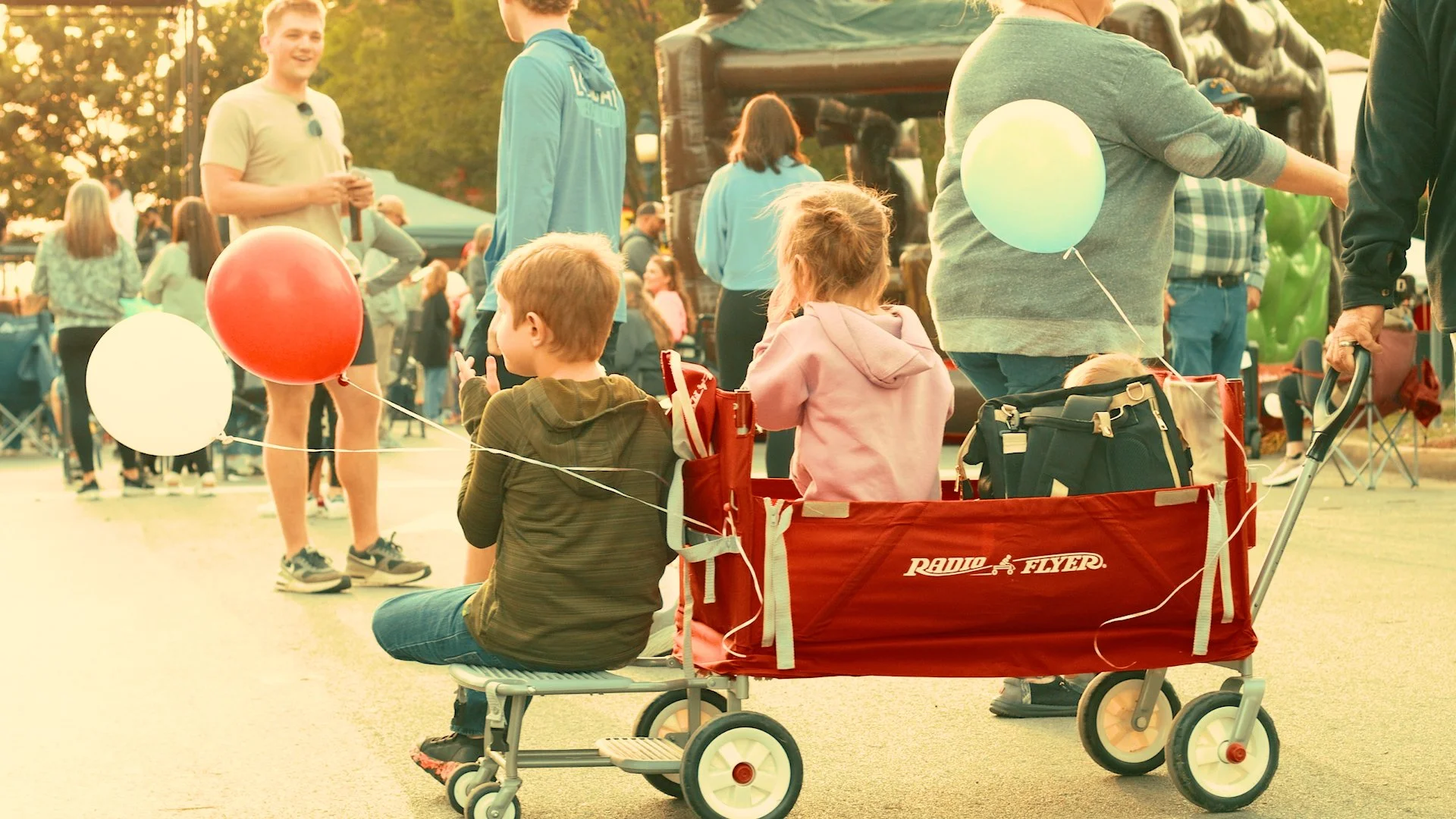
A street fair may look like music, food trucks, vendors, cars, children, and neighbors visiting under the streetlights. And it is all of that. But it is also a strategy.
First Friday helps re-establish downtown as the center of community life. It gives people a reason to come to the Square, introduces visitors to local businesses, creates vendor opportunities, builds positive memories, and reminds residents that their hometown still has energy worth showing up for. As a 2022 feature noted, Heart saw events life First Friday as a way to re-establish downtown as the place where neighbors connect and small businesses thrive.
That matters because people invest in places they feel connected to.
They volunteer where they feel ownership. They shop where they feel welcome. They bring guests where they feel proud. They donate when they can see progress. They start businesses where they sense momentum.
Events are not the whole strategy. But in a small town, they are often the front door to the strategy.
THE FIELDSTORE IS PLACE-BASED ECONOMIC DEVELOPMENTThe same is true of The Fieldstore, Heart of Scottsville’s gift shop on the Square.
Opened in October 2024, The Fieldstore was created as a warm, welcoming shop that celebrates the culture and hospitality of rural Kentucky. It carries local makers, Kentucky-made goods, Scottsville merchandise, and seasonal items, and every purchase supports Heart’s broader downtown work— including events, merchant support, public projects, storytelling, and revitalization.
That is place-based economic development at a human scale.
The Fieldstore gives visitors a way to take a piece of Scottsville with them. It gives residents a place to find something meaningful close to home. It gives makers and local goods another point of connection. It gives Heart a daily presence on the Square.
Most importantly, it gives people an easy way to participate.
Not everyone can write a grant, serve on a board, sponsor an event, or restore a building. But many can buy a gift, bring a friend downtown, tell someone about a local shop, volunteer for a shift, or choose to spend a little more of their money close to home.
That counts.
MAIN STREET IS THE FRAMEWORKThe national article pointed out that revitalization rarely fits into neat categories. Workforce, community, and business development overlap constantly.
Main Street America understands that.
The Main Street Approach organizes local revitalization around four broad areas: Economic Vitality, Design, Promotion, and Organization. Each piece supports the others. Economic Vitality helps businesses and investment grow. Design supports the physical environment. Promotion tells the story and creates reasons to gather. Organization builds the partnerships, volunteers, funding, and leadership to sustain the work.
Heart of Scottsville is a nationally accredited Main Street America program, which means its work is part of a proven preservation-based economic development model. Locally, Heart’s own work is organized around those same four points: helping downtown business and investment grown, supporting a safer and more beautiful district, telling the story of downtown, and building the partnerships and resources needed to keep going.
That is why Heart is not just an event committee.
It is not just a beautification group.
It is not a city department.
It is not a grant machine.
Heart is a community development partner working at the intersection of people, place, preservation, and economic vitality.
THE WORK BELONGS TO ALL OF USThe hardest truth about revitalization is also the most hopeful one: no single organization can do it alone.
Not Heart of Scottsville. Not the City. Not the County. Not the Chamber. Not one business owner. Not one donor. Not one volunteer. Not one grant.
Real revitalization takes many hands moving in the same direction.
It takes public partners willing to work through infrastructure and policy. It takes property owners willing to care for old buildings. It takes entrepreneurs willing to take risks. It takes residents willing to shop local when they can. It takes sponsors and donors willing to fund the work people see— and the work they do not see. It takes volunteers willing to show up early, stay late, and do unglamorous tasks with good humor. It takes young people being invited into the conversation. It takes longtime residents and new neighbors deciding that downtown still matters.
That is the lesson from Scottsville, and form the small cities across the country trying to build a stronger future without losing their soul.
Revitalization is not magic.
It is not nostalgia.
It is not one big fix.
It is a practice.
It is the steady decision to keep tending the heart of the community— with strategy, hospitality, preservation, partnerships, and price.
And in Scottsville, that work is already underway.
